"Shoving their shields together, they shoved, fought, slew, and died" (Xenophon). Can the deep Theban right stop Agesilaus from reaching home?
This battle was fought between Agesilaus of Sparta and Thebes.
Agesilaus was marching home.
The Thebans tried to stop him. Agesilaus blamed the Thebans for ruining his plans of Persian conquest, so he wanted them dead. His hatred caused him to adopt a rash plan of battle. Instead of letting the Thebans run away, Agesilaus took them head-on in a bloody front to front clash. Casualties were enormous. Sparta won, but the deep Theban phalanx (a premonition of Leuctra, see above) broke through the Spartan line, and some Thebans reached sanctuary in a temple.
Cunaxa was fought in Persia between the two half brothers Artaxerxes and Cyrus. Artaxerxes was king. Cyrus wanted to be. The cream of Cyrus's army was his force of Greek mercenaries, commanded by the Spartan Clearchus, placed on the right wing. These carried all before them, but the day was lost when Cyrus, seeing his hated half-brother, charged his 6000 cavalry with his own 600, and got himself killed. Silly sod. The 10,000 Greek mercenaries (including the historian Xenophon) then faced a heroic march home through hostile territory.
Cyrus and Artaxerxes, sons of Darius, battle to be Great King. Artaxerxes has the numbers, Cyrus the Greek Hoplites--and his own hot head.
In the largest land battle yet fought between Greeks, Sparta quells its rebellious allies.
The battle of the Nemea river was fought between Sparta and its rebellious allies while Agesilaus was in Asia.
Sparta won by her usual tactic of crushing the enemy's left wing, then turning on the victorious right as they were streaming back over the battlefield. (Sparta did the same thing at
First Mantinea.)
Books on Sparta - used by the Scenario Author
Submitted by John Leonard
Epaminondas refuses his right and attacks heavily with his left--a formidable array of Theban hoplites, ranked fifty deep, and led by the Sacred Band. Can Kleombrotus' Spartans weather the storm?
Strategy guide
The Spartan right and the Theban left wings are both offensive, and the Spartan left and the Theban right are both defensive. This fits the historical facts
as reported by Xenophon and Diodorus Siculus. Sparta's allies on the left might not even have fought.
They were "not displeased" with Sparta's defeat. One can of course play the Spartan left offensively so as to find out what might have happened if Sparta's allies had fought.
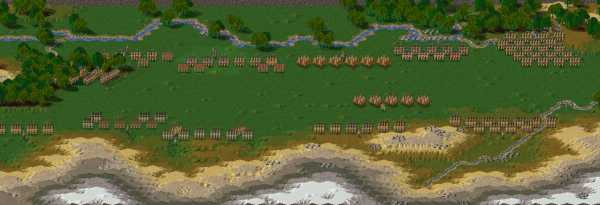
Athens is now with Sparta, Tegea with Thebes. As at Leuctra nine years earlier, Epaminondas' deepens his left and catches the Spartans by surprise.
Strategy guide
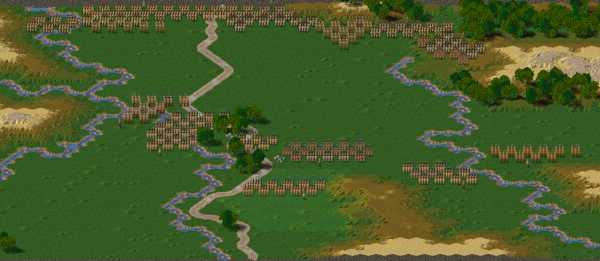
Epaminondas repeated his success, attacking the Spartans before they were even in battle line.
Once again, he deepened his left wing. Sparta had not learned the lesson of Leuctra. But the Theban victory was soured when Epaminondas was killed in the moment of triumph--thrust through the chest by a Spartan spear.
Submitted by John Leonard
Strategy guide
Strategy guide
Submitted by John Leonard
Submitted by John Leonard
Strategy guide

Submitted by John Leonard
